
UK Division of Regulatory Services launches Forage Testing Program to support Kentucky livestock farmers
UK Division of Regulatory Services launches Forage Testing Program to support Kentucky livestock farmers


The University of Kentucky Division of Regulatory Services (UKDRS), in collaboration with the Kentucky Department of Agriculture and the Cooperative Extension Service, has officially launched its Forage Testing Program to help Kentucky producers improve livestock nutrition, reduce feed costs and promote sustainable agriculture.
With support from the Kentucky Agricultural Development Fund, trial testing began in September 2025, and the program is now fully operational, offering comprehensive nutritional analysis of forages.
Ray Smith, Extension forage specialist in the Department of Plant and Soil Sciences at UK Martin-Gatton College of Agriculture, Food and Environment, said he is pleased that UKDRS is now offering this high-quality forage testing.
“This will be a tremendous benefit to livestock and hay producers in the state,” Smith said. “Having this testing at the same location as UK Soil Testing offers a user-friendly format and quick turnaround. It also facilitates county Extension agents working with specialists to explain the results to their clients.”
The benefits of forage testing
According to Smith, forage makes up more than 80% of most ruminant and equine diets, yet many horse owners and livestock producers feed hay or ensiled forages without knowing their nutritional value.
To know how to best use hay to meet a horse’s nutrient needs, UK associate professor and equine nutrition specialist Bob Coleman says horse owners need a forage analysis.
“Feeding hay is just part of owning horses,” Coleman said. “Having the analysis tells a lot about the hay, allowing horse owners to make better use of the hay and their feed budget. It is exciting to have this service available at UK.”
Experts also agree that most cattlemen wouldn’t buy a bag of feed labeled only ‘Cattle Feed’ without nutrient guarantees.
"Forage testing provides the foundational information to build a cost-effective supplement strategy to meet the nutritional needs of beef cattle and ensure performance goals are met,” said Jeff Lehmkuhler, Extension professor of beef cattle nutrition. “Without this information, we are using book values, which may lead to overspending on unnecessary supplements or lost production due to nutritional deficiencies.”
For producers who sell their hay, forage testing allows producers to assess market value, monitor quality changes and make informed sales decisions. It also supports participation in the KDA’s hay grading program.
Standard analysis and cost
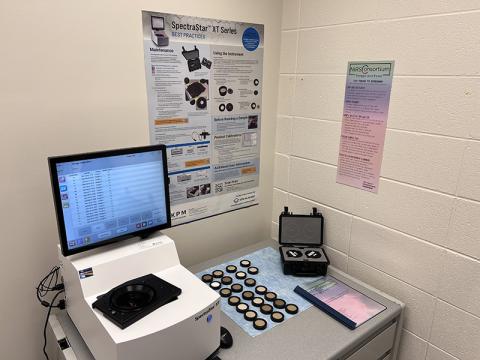
The UKDRS Forage Testing Program uses Near Infrared Spectroscopy (NIR) — a technique that uses near-infrared light to analyze the chemical and physical properties — to analyze samples for moisture and dry matter, crude protein, fiber, sugars, starches, minerals, energy values and digestibility. The standard test is $22 per sample; silage and haylage samples are tested for pH at no additional charge. Optional wet-chemistry mineral analyses are available for an extra fee.
Once testing is complete, a process that averages three business days, producers can work with their local Extension agents to interpret the results and balance rations for ruminants or equines. Reports are reviewed for accuracy, and retesting is free if requested within seven days of the report date.
Changes to KDA Forage Program
By transitioning forage testing to UK, KDA will retire its forage testing program and expand its forage marketing services by adding hay grading and a monthly USDA hay market report.
“It made sense for producers that KDA transitioned the state’s forage testing program to the University of Kentucky Regulatory Services,” Agriculture Commissioner Jonathan Shell said. “Farmers who are already utilizing the soil lab through their local extension agent can now add a follow-up forage analysis and consultation through UK Cooperative Extension, resulting in a more complete soil and forage improvement plan.”
Producers who test their hay for marketing purposes through a certified lab, such as UKDRS, can submit results to KDA. That lot will then be assigned a USDA hay quality grade and included, free of charge, on the KDA “Hay for Sale” website.
Untested hay may also be listed on the Hay for Sale site, but it will not show a quality grade and will not have an analysis to verify the quality. Submitting the analysis to KDA is as simple as checking the box on the UK Sample Submission Form to email results to “KDA for Marketing.”
Another new addition to the KDA hay program is the monthly hay market report, a collaboration among producers, KDA staff and USDA. KDA will gather Kentucky hay sales data monthly and submit it to the USDA for publication of the market report. Anyone interested in participating in the monthly hay market report by providing their sales data can contact KDA’s hay program coordinator Kimberly Field at Kimberly.Field@ky.gov.
Submitting samples
Jenny Combs, agriculture research specialist and administrator of the Forage Testing Program, said proper sampling is critical.
“Producers or agents should collect a representative core sample and clearly label the samples and services requested on the sample form,” Combs said.
Combs also recommends that producers and Extension agents complete the free one-hour hay-sampling course offered by the National Forage Testing Association (NFTA) at https://www.foragetesting.org.
Once samples are collected and labeled, Combs said they should be delivered or shipped via UPS or FedEx during regular lab hours: Monday through Friday, 8 a.m. to 4 p.m. ET. Haylage should not be shipped on Fridays due to the risk of mold.
Samples should be shipped to:
Regulatory Services
Attn: Forage Testing Program
103 Regulatory Services Building
Lexington, KY 40546-0275
Craig Wood, assistant director for agriculture, natural resources and horticulture with UK Extension, said the Forage Testing Program is a valuable resource for Kentucky’s agricultural community.
“By providing accurate, science-based forage analysis, it empowers producers to make smarter decisions, improve animal health and enhance profitability," Wood said.
For more information on the UKDRS Forage Testing Program, visit https://www.rs.uky.edu/ForageTesting or contact the program at UKDRSforage@uky.edu or 859-218-2449.
###
Writer: Jennifer Elwell, jennifer.elwell@uky.edu
The Martin-Gatton College of Agriculture, Food and Environment is an Equal Opportunity Organization with respect to education and employment and authorization to provide research, education information and other services only to individuals and institutions that function without regard to economic or social status and will not discriminate on the basis of race, color, ethnic origin, national origin, creed, religion, political belief, sex, sexual orientation, gender identity, gender expression, pregnancy, marital status, genetic information, age, veteran status, physical or mental disability or reprisal or retaliation for prior civil rights activity.
Animal & Food Sciences Plant & Soil Sciences
Related News

UK faculty honored with 2025 Master Teacher Award for commitment to student excellence

By Christopher Carney
Published on
Optimize spray applications with KATS drone pattern testing fly-in workshop
By Jennifer Elwell
Published on

2026 Kentucky Crop Health Conference helps farmers address pest challenges in the new year
By Jennifer Elwell
Published on